
Treatment plans rarely stay frozen. A patient signs up for a crown, then the dentist finds a hidden fracture. A simple filling turns into a root canal. Clear aligner therapy stretches from 12 months to 18. Every one of these shifts changes the dollar amount. And when the amount changes, the payment paperwork you collected weeks ago may no longer be valid.
That gap is where practices can take a financial loss. Chargebacks, disputes, and compliance headaches arise there as well. If you end up charging a card or taking a bank draft for a number that the patient never truly authorized, you are at risk. The solution is straightforward in concept and easy to dismiss in a busy front office. You are required to amend the patient payment authorization.
This guide shows you how to properly do this for your practice. You will understand what payment authorization covers, the reasons for the problems that treatment changes create, and most importantly, how to maintain all stored cards and drafts to avoid disputes and remain compliant.
What a Patient Payment Authorization Actually Covers
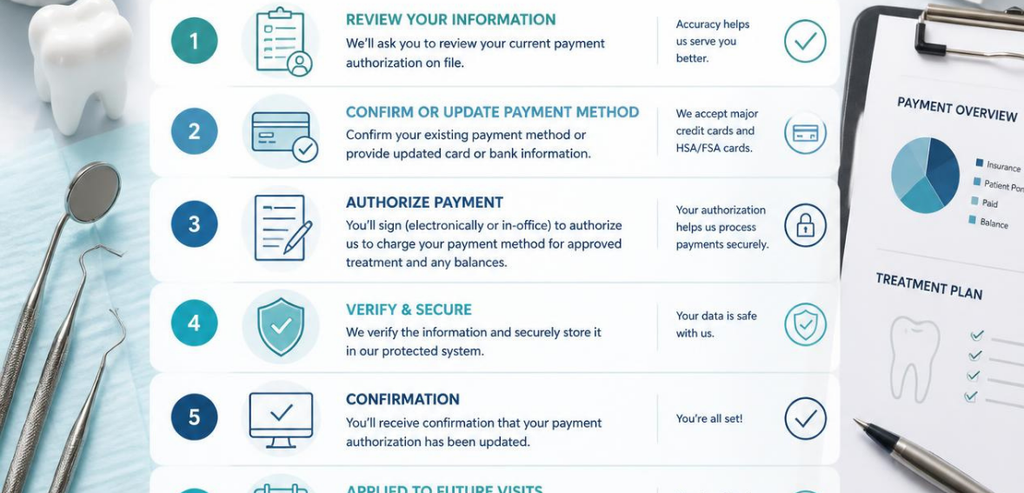
A patient payment authorization is the patient’s written permission to charge a specific payment method for a specific reason. It ties a card or bank account to an agreed dollar figure, a schedule, and a purpose. Think of it as a contract, not a convenience.
A dental payment authorization form is the document that records the method and frequency of payment, the amount or a method to determine the payment amount, and most importantly, the patient’s signature. The patient’s signature is the most important aspect of this form. In a chargeback dispute, it is often the only thing that protects your practice from losing the claim.
Most practices miss this. A payment authorization is limited to the scope defined in the agreement. If the patient authorized a payment for a $1,200 crown to be paid in three equal installments, the agreement does not authorize a payment for a $2,800 root canal and buildup. Financial agreements must be revised if the clinical picture and corresponding costs also change. Otherwise, you are billing for services rendered without the required authorization.
Why Treatment Changes Break the Original Authorization
Dentistry is diagnostic by nature. You cannot always see the full scope until you are in the tooth. So treatment plans evolve, and the numbers move with them. When they move, three things can go wrong with the original authorization.
First, the amounts likely do not match. A card charged for an amount greater than the amount approved by the patient is likely to cause a “transaction not recognized” dispute. Second, the schedule likely does not match. More treatment generally means more payment plans, and each new payment plan needs a guiding reason. Third, the agreement likely does not match. A patient who agreed to an orthodontic payment plan did not agree to a payment plan for periodontal surgery.
The American Dental Association explains that even insurance pre-estimates are not guarantees, because the insurance coverage is determined at the time of service, not at the time of the pre-estimate. More information can be found in the ADA’s overview of dental pre-authorizations. This reasoning is the same for a patient’s out-of-pocket cost. What you quoted last month is not what you can charge today, so reconfirming the amount protects both parties.
What a Strong Dental Payment Authorization Form Includes
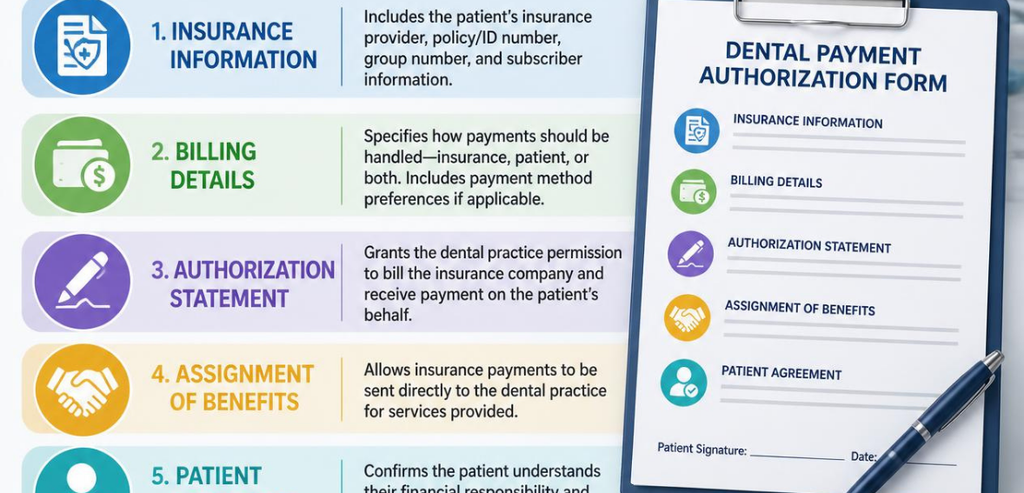
A well-built dental payment authorization form does more than capture a card number. It creates a paper trail that holds up under scrutiny. The strongest forms spell out the total treatment cost, the amount being financed, and the exact charge schedule in plain language. They name the payment method and confirm the patient consents to keep that method on file for future charges tied to this treatment.
The form should explain how variable amounts will be calculated for phased treatments when the final amount is unknown. If you are unable to provide the final amount, explain how the amount will be calculated. This is what the card networks expect. Revocation clauses also belong in the form to let the patient know how they may cancel the arrangement and what the required notice period will be. Lastly, the form will become a binding contract once a dated wet signature or a secure e-signature is provided.
There is one area of concern that you need to be especially careful about when it comes to privacy. While card numbers do not constitute protected health information, the fact that someone is a patient in your office does constitute protected health information. Therefore, the way you handle the forms needs to keep in mind both HIPAA and PCI compliance. Never store complete card numbers in your practice management software or on a local hard drive. Always use a payment processor that tokenizes and vaults the data for you.
How to Update Patient Payment Authorizations After Treatment Changes
When treatment changes, the update process should be quick and consistent. Start by re-presenting the numbers. Sit with the patient, or reach them by phone or secure message, and walk through the revised treatment cost and the new balance they owe. Transparency here prevents almost every downstream dispute.
Next, obtain new consent. Don’t edit the old form and reuse the old signature. Create a new authorization with the new amount, the new schedule, and the new purpose. Have the patient sign it. If your platform allows e-signature, send it while the patient is still engaged. After the session, the approval rate will decrease.
Then, update the stored consent on your payment platform. Do not rely on a paper copy alone. Attach the new charges to the new authorization. Keep the old form for history, but make the new one the active agreement. If the change increased a recurring charge, notify the patient before the next charge.
Everything must be confirmed in writing. An email or text summarizing the new amount and the date of the next charge will provide the patient with a record and you with a timestamp in case of a future dispute. The confirmation along with the signed form is your defense.
Compliance Rules You Cannot Ignore
Two rulebooks govern most of what happens when you charge patients on file. Ignoring either one puts your merchant account at risk.
NACHA and ACH Bank Drafts
If your practice uses the ACH network to draft patient bank accounts, you must follow NACHA’s operating rules. All debits must be approved and must include the amount, timing, and purpose of the debit. You must keep the authorization for at least two years from the date of the last payment. The rule that most often confuses dental offices is that you are required to notify the patient of a draft request at least 7 to 10 days before the debit if the amount is changing. Failure to provide the notice permits the patient to contest the draft as unauthorized, which will jeopardize your practice’s return rate.
NACHA is also aware of “standing authorizations,” which provide some leeway concerning charges that occur with some frequency and that are not scheduled to occur. For an exact view of the rules, you should visit NACHA’s rules resources. For an easy-to-follow, plain-language explanation concerning the overlap of NACHA and Regulation E, the ABA has a great comparison of payment authorization.
Card Networks and Stored Credentials
If you keep cards on file, Visa and Mastercard’s stored credential mandate applies. Before the first charge, you must obtain the cardholder’s express, informed consent and keep that agreement for as long as it stays in effect. The agreement must state the transaction amount, or explain how the amount will be calculated when the exact figure is not yet known. Critically, the networks require you to notify cardholders whenever the terms of use change.
A treatment change that alters the amount or schedule is exactly that kind of change. Notify, re-consent, then charge. Non-compliant transactions also see higher declines, so staying clean protects your revenue, not just your record.
Best Practices for Front Desks and Financial Coordinators

The most successful offices build this into regular workflow rather than treating it as an exception. Require a re-authorization every time a treatment plan is amended. Have the re-authorization take place when the amended plan is signed. Have financial coordinators read the number out loud and verify it prior to proceeding to the transaction when a card is stored. Use the payment system that timestamps the consent, tokenizes the stored card, and retains the authorization for you. This will automate compliance and eliminate the paperwork hassle.
Rephrasing will also shift the mindset. Frame the re-authorization around the benefit to the patient and the need for clarity. When this is understood, the majority of patients will not contest the charge. Financial policy forms should be reviewed every year. This will allow for patient understanding of the financial policy and prevent unwanted charge disputes.
Common Mistakes That Lead to Disputes
The worst mistake is probably reusing an old authorization for a new amount. Although it seems efficient, it’s a liability. There’s almost an even bet that a chargeback would be lost if there was a slightly higher amount charged in a case involving an old authorization. Closely following that mistake is the failure to provide an ACH change notice, which would mean that a routine draft would result in an unauthorized return.
Another mistake that is also avoidable and a violation of PCI standards is the storage of complete card numbers in a spreadsheet or practice software. Finally, verbal approvals leave no documentation, and therefore no defense. Always obtain a signature, document it, and provide written confirmation.
Conclusion
Treatment plans change. That is normal, and your payment process should expect it. The practices that protect their revenue are the ones that treat every treatment change as a trigger to refresh the patient payment authorization. Re-present the numbers, capture a new signature on an updated dental payment authorization form, update the stored credential on a compliant platform, and confirm in writing.
Do that consistently and you close the gap where disputes and lost revenue live. You stay aligned with NACHA rules, card network mandates, HIPAA, and PCI. Most of all, you keep your patients’ trust, because they always know exactly what they approved and why. A few extra minutes at the point of change saves hours of chargeback headaches later, and it keeps your merchant account healthy for the long run.
Frequently Asked Questions
Do I need a new authorization every time a treatment plan changes?
Yes, whenever the change affects the amount, the schedule, or the purpose of the charge. Minor clinical adjustments that do not move the price may not require a new form, but any change to what the patient pays should be re-authorized in writing. When in doubt, re-confirm. It costs you a minute and protects you from a dispute.
Can I just charge the patient’s card on file for the higher amount?
No. A stored card is authorized for a specific amount or a disclosed calculation method. Charging more than the patient approved, without new consent, is a leading cause of chargebacks and can put your merchant account at risk. Update the authorization first, then charge.
How long do I have to keep patient payment authorization records?
For ACH bank drafts, NACHA requires you to retain the authorization for at least two years after the final payment. Card network rules require you to keep stored credential agreements for as long as they remain in effect. Many practices keep records longer as a safeguard against late disputes.
Is a patient’s credit card number protected health information under HIPAA?
The card number itself is not PHI. However, the fact that someone is your patient is protected. Because your authorization forms connect a payment method to a patient relationship, handle them with both HIPAA and PCI safeguards. Use a platform that tokenizes card data instead of storing raw numbers.
Leave a Reply