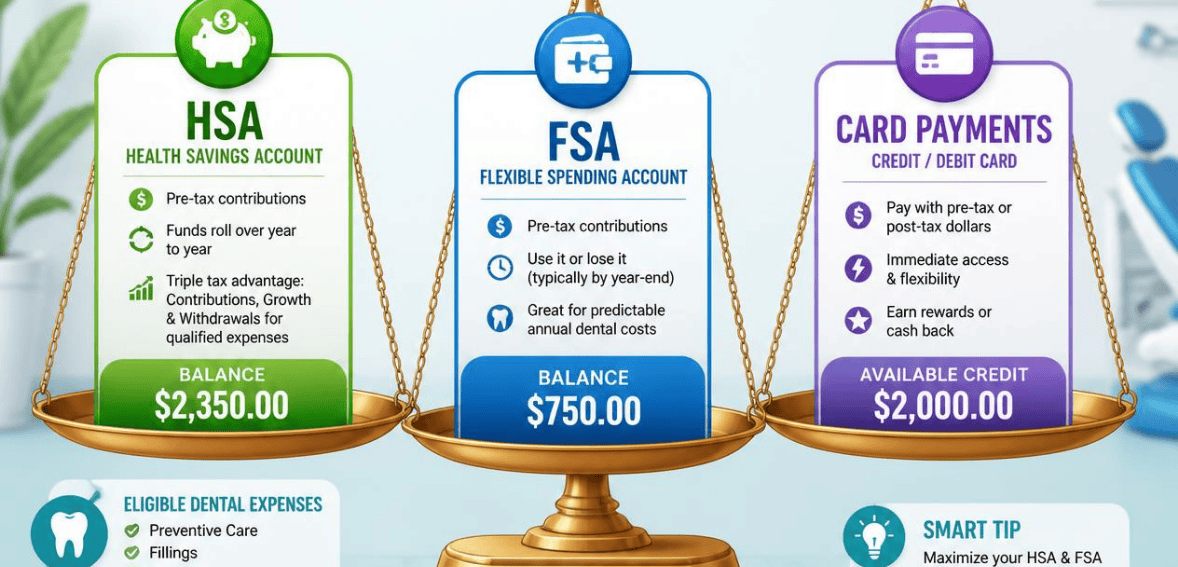
Paying for dental treatment is not always as simple as swiping one card. Many dental appointments include both eligible and non-eligible expenses under Health Savings Accounts (HSAs) or Flexible Spending Accounts (FSAs). A patient may receive a medically necessary procedure along with cosmetic services during the same visit. Because IRS rules limit what you can pay with tax-advantaged healthcare accounts, patients often need to split the bill between an HSA or FSA card and another payment method.
This is where split HSA and FSA payments for dental services come into play. Today’s dental practices can legally process the same invoice using different payment methods to help balance the payment and be fully compliant with IRS rules. This advancement helps practices improve the overall experience for the patient. The same invoice may be paid with an HSA card, an FSA debit card, a credit card, or any combination of the three.
This document explains the mechanics of split HSA and FSA payments, what dental services these payments can be used for, how these mixed dental payments are streamlined with merchant services, and what best practices are available to help dental offices reduce payment friction and improve payment collections.
Understanding Mixed Dental Charges

Dental invoices frequently include services that fall into different tax categories. Some treatments are considered medically necessary and qualify for payment through an HSA or FSA. Others are elective or cosmetic and must be paid using another funding source.
A patient could have both a dental crown procedure and a teeth whitening procedure done. Dental crowns as a medical expense are a legitimate expense eligible for reimbursement, but teeth whitening is a cosmetic expense and is not reimbursable. Thus, to process the payment, the practice must separate the crown from the whitening, which establishes a mixed dental charge.
Since the practice cannot put both the crown and the whitening on the HSA card, the staff has to find a way to communicate to the patient why the payment for the crown is a charge and for the whitening it is not, which is often frustrating for both staff and patient and can often lead to error and thus imbalance in the accounting records. Simplifying the HSA/FSA payment process for dental expenses resolves these issues and improves the overall payment process.
What Are HSA and FSA Eligible Dental Expenses?
The Internal Revenue Service allows HSAs and FSAs to cover many dental procedures that diagnose, prevent, or treat dental disease. Eligible expenses generally include examinations, cleanings, fillings, crowns, bridges, root canals, periodontal treatment, tooth extractions, dentures, dental implants that meet medical necessity requirements, and medically necessary orthodontic treatment.
Generally speaking, cosmetic procedures are not covered. Treatments that are purely cosmetic such as teeth whitening and cosmetic veneers, will likely not be covered and paid for by an HSA or FSA.
Eligibility will depend on individual circumstances and guidance from the IRS so dental practices should avoid making tax determinations for patients. Practices should itemize services on an invoice and distinguish what is covered and what is not. Patients should discuss non-covered services with their HSA administrator or tax professional.
Why Dental Offices Need Split Payment Options

Patients prefer payment options that match what they find with retailers. A failure to provide multiple payment options means your dental practice will have checkout friction that customers will want to avoid.
What are your options when a patient has $800 in their HSA, a $1,400 bill, and no credit available? The $800 HSA balance does not need to be a barrier to payment for your practice.
Offering this flexibility means your patient maximizes payment options, your practice lowers the amount and therefore the time spent on outstanding payments, and your employees save time adjusting invoices due to payment discrepancies.
In an environment of increasing costs in healthcare, and an expectation from customers of payment flexibility, this payment flexibility becomes an asset your practice cannot afford to be without.
How Split HSA, FSA, and Card Payments Work
The first step in a split HSA/FSA dental payment is correct billing. The dental office separates the service procedures that qualify under IRS regulations from the other procedure services within their practice management or payment processing system prior to billing.
After determining the eligible amount, the patient is required to pay that amount using their HSA/FSA debit card. The remaining balance is then paid using another payment method, such as Visa, Mastercard, American Express, Discover card, debit card, a digital wallet, or a financing option.
Most payment systems used today allow the office staff to complete the two payment transactions under one unified payment flow. The two payment records are still maintained under one patient visit for highly accurate accounting and reporting.
When payment systems are designed to integrate with practice management systems, eligible amounts, payment allocation, and receipts can be tracked automatically. This decreases the administrative burden and the errors related to reconciliation.
Step-by-Step Example of a Mixed Dental Payment

Imagine a patient visits a dentist for a crown replacement and also decides to add professional teeth whitening before an upcoming wedding. The total invoice comes to $1,600. The crown costs $1,100 and qualifies as an eligible medical expense. The whitening treatment costs $500 and is considered cosmetic.
Rather than requiring the patient to make multiple trips or requests for multiple invoices, this dental practice bills one visit using two payment methods. The first $1,100 is charged to the patient’s HSA card, and the balance of $500 is charged to a personal credit card. The receipt shows both payment methods with the amounts related to each treatment appropriately listed. The patient benefits from a simple checkout process, and the dental practice retains an accurate record of their account.
Benefits for Patients
The split payment approach has become more popular with patients due to the increase in the flexibility of payments. This is because the cost of healthcare involves multiple payment sources and split payments allow patients to use the balance of their Health Savings Account (HSA) or Flexible Spending Account (FSA) if available to cover the costs of healthcare, while the patients pay the balance using another payment method.
When a patient uses split payment, it also eliminates questions and confusion during tax season. This is accomplished because the patient gets one receipt that has documented both qualified and non-qualified tax payment expenses.
Additionally, split payments provide a consistent payment method that minimizes billing concerns, provides assurance that accounts are properly utilized and optimizes the payment experience for the patient. This consistent payment experience creates a relationship with the patient that optimizes their satisfaction with the practice.
Benefits for Dental Practices
Improved collections and efficiency mean less time spent by your staff on payment-related queries. This is because your payment system accommodates various funding sources.
With integrated merchant services, staff will appreciate less time spent on reconciling the accounts due to the diverse payments automatically recorded within the patient’s account. Less time spent also means more accurate reporting and end-of-day balancing.
Offering flexible payment options will likely increase your practice’s treatment acceptance. Patients will be more inclined to schedule the treatment that was previously deferred due to payment concerns when they know that HSA funds can be combined with other payment options.
Payment Processing Considerations for Dental Offices
Finding the right payment processor can help support your split healthcare payment needs. When looking at different payment solutions, dental practices should find offerings that create an integration with their practice management software, support multiple tender types within a single transaction, provide detailed reporting on transactions, maintain PCI DSS compliance, and utilize secure tokenization of payment data.
Your payment solution should also be able to generate detailed receipts with clear payment allocation and require the least amount of manual payment adjustment. This improves operational efficiency and patient confidence at the time of payment.
Because the payment security standards for healthcare continue to change, having reliable merchant services that support split payment services becomes critical for any practice that deals with sensitive financial information.
Square
Square has payment solutions customized for many healthcare providers, including dentists. Their payment services support several payment types, digital wallets, contactless payment, and reporting. As practices should check with their dental software for compatibility, Square is popular with smaller, growing practices for their flexible checkout and payment acceptance options.
Stripe
Stripe provides powerful payment infrastructure for businesses that require customized payment workflows. Dental software vendors frequently integrate Stripe into practice management platforms, allowing providers to create flexible payment experiences while maintaining strong security standards. Stripe also supports recurring payments, online invoices, and digital payment options that improve patient convenience.
Clover
Clover is a provider of integrated payment terminals as well as other cloud-based merchant solutions for healthcare providers. Dental practices can utilize payment processing for card, contactless, and mobile wallet payments, and can access reporting tools for payment management. Clover can integrate with other business management solutions depending on the merchant services provider.
Common Mistakes to Avoid When Processing Split Payments
Many payment problems occur because staff members accidentally charge the full invoice to an HSA card without separating cosmetic services from qualified medical expenses. In other situations, practices fail to provide itemized receipts, making it difficult for patients to document eligible healthcare spending. Some offices also rely on outdated payment terminals that cannot process multiple payment methods efficiently, resulting in manual workarounds that increase the likelihood of errors. Regular staff training, updated payment software, and clearly documented payment procedures significantly reduce these issues while improving the patient experience.
IRS Rules and Documentation Requirements
Innovations in payment technology improve transactional ease but do not eliminate tax obligations. Dental practices should keep accurate treatment records and charge itemized bills, which show clear delineation of qualified vs. non-qualified (cosmetic) services. Patients should keep a copy of these bills to substantiate tax-related medical expense claims and for possible IRS scrutiny.
Practices should remember they are responsible for billing accurately, not to counsel on tax issues. Patients should reach out to their HSA or FSA administrator or their tax advisor to clarify concerns on expense chargeability.
The IRS is the final authority on qualified healthcare expenses, and it is recommended that providers stay current on publications of the IRS.
Best Practices for Dental Practices
The most successful dental offices establish payment procedures to settle accounts before patients arrive at the checkout desk. During the treatment plan, the coordinators need to inform patients or clients about which procedures are eligible for payment via HSA or FSA before the time of service, rather than during the checkout process. The practice management software needs to separate those procedures, while the payment terminals need to accommodate multiple payment methods for the same visit.
The absence of the IRS eligibility basics, receipt generation, payment reconciliation, and employee communication of the aforementioned in the staff training means that the payment transactions are bound to be complicated and cumbersome. All these operational changes will enhance a patient’s experience at a dental office, while minimizing the disruptions associated with billing and payment disputes.
Choosing the Right Merchant Services Provider
Instead of evaluating merchant services in terms of payment processing costs, dental practices should consider them as an investment. When assessing merchants, practices should consider payment options, integrations with healthcare software, payment security, reporting, pricing, support, and scalability. A merchant services provider that offers split HSA and FSA payment processing will meet your patients’ needs and make your practice more efficient.
The convenience of payment flexibility has been shown to attract and retain patients. Practice growth needs to have modern merchant services in place. The right solution has the potential to increase your practice’s revenue and improve your collection process.
Conclusion
Managing mixed dental charges requires more than accepting a single payment method. Patients frequently receive invoices containing both eligible medical expenses and non-qualified cosmetic treatments, making flexible payment processing essential. A well-designed split HSA FSA dental payment workflow allows practices to allocate qualified expenses to HSA or FSA cards while collecting the remaining balance through traditional payment methods without creating unnecessary complexity.
Modern merchant services, integrated payment software, and clear billing procedures help dental offices improve collections, reduce administrative work, and deliver a more convenient patient experience. By understanding IRS guidelines, investing in flexible payment technology, and training staff effectively, dental practices can confidently process mixed dental charges while maintaining compliance and building stronger patient relationships.
Frequently Asked Questions
Can patients use both an HSA card and a credit card for one dental visit?
Yes. Many dental practices can split the invoice, allowing eligible expenses to be paid with an HSA card while the remaining balance is paid using a credit card, debit card, or another accepted payment method.
Are cosmetic dental procedures HSA or FSA eligible?
Generally, no. Procedures performed solely to improve appearance, such as teeth whitening, are typically not considered qualified medical expenses under IRS rules. Patients should verify eligibility with their HSA or FSA administrator.
Do dental offices need special payment software for split payments?
Most modern merchant service platforms and integrated dental practice management systems support multiple payment methods within a single transaction. The exact functionality depends on the payment processor and software integration.
Why is itemized billing important for split HSA FSA dental payments?
Itemized invoices clearly separate qualified and non-qualified expenses, making payment allocation easier and helping patients maintain accurate documentation for tax and reimbursement purposes.
Leave a Reply